
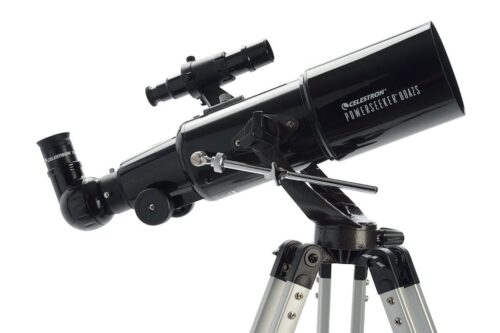
Looking for the best telescopes for kids? If your answer is yes, you are in the right place. Read on, this comprehensive buying guide is for you.
Exploring the night sky with your kids sparks a lifelong love of science and discovery, and there’s no better way for kids to start than with their telescope. This guide breaks down the best telescopes for kids of different ages and interests, helping you find a telescope that’s safe, sturdy, and perfect for beginner stargazing. Whether your child is just curious about the moon and stars or ready to dive deeper into the cosmos, we’ve got you covered with reliable picks.
Why Telescopes are Great for Kids
Telescopes open up a whole new world for children by turning the night sky into an exciting, hands-on learning experience. Instead of just reading about space, kids get to explore it for themselves, making astronomy both fun and educational.
The best telescopes for kids are also essential for:
1.Encouraging curiosity about space. Telescopes spark interest in planets, stars, and galaxies beyond what kids see in books or videos.
2. Supporting STEM learning. They introduce basic concepts in science, technology, engineering, and math in a fun, practical way.
3. Makes learning interactive. Kids can observe lunar craters, planets, and star clusters firsthand.
4. Reinforce classroom lessons. Moreover telescopes help bring science topics taught at school to life.
5. Build patience and focus. Stargazing teaches careful observation and persistence. It also encourages kids to spend time outside and away from screens.
6. Encourage family bonding. Exploring the night sky together creates meaningful shared experiences.
7. Develop problem-solving skills . Last but not least, setting up and adjusting a telescope improves coordination and logical thinking. Both are critical for developing problem-solving skills in kids.
Best Telescopes for Kids
1) Gskyer Telescope, 70mm Aperture
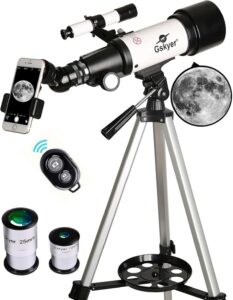
The Gskyer Telescope is the best telescope for kids. It is built with ease of use in mind to spark curiosity about the night sky.
With its 70mm aperture, it gathers enough light to deliver bright, clear views of the Moon’s craters, Jupiter’s moons, and even some brighter star clusters. Furthermore, the 400mm focal length keeps the tube compact and lightweight, making it easy for kids and beginners to handle without feeling overwhelmed.
The included AZ (alt-azimuth) mount is simple to operate, allowing smooth up-and-down and left-to-right movements that beginners can quickly master. Moreover, its refractor design requires minimal maintenance compared to reflector telescopes, and the fully coated glass optics help enhance image clarity and contrast for casual stargazing sessions.
Setup is also straightforward, and the adjustable aluminum tripod provides decent stability for backyard observing.
Pros
- 70mm aperture provides bright, clear beginner-level views
- Lightweight and portable design
- Easy-to-use AZ mount for smooth tracking
- Low-maintenance refractor optics
- Adjustable tripod for comfortable viewing
- Good value for beginners and kids
Cons
-
Limited magnification for deep-sky objects
- The accessories included require upgrading over time
2) YENGUAN Telescope
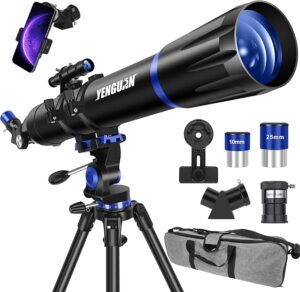
The YENGUAN 90 mm Aperture Telescope delivers an impressive mix of power and portability that’s ideal for beginner and intermediate stargazers.
The 90 mm aperture gathers a generous amount of light, which brings planets like Jupiter and Saturn into clearer view than many entry-level models. Furthermore, the included eyepieces provide a useful range of magnifications, and the views of the Moon’s craters and lunar seas are outstandingly crisp and engaging.
For added convenience, the assembly process is straightforward, with intuitive adjustments that make it easy to start observing without spending hours on setup. Besides, the telescope’s mount holds steady during viewing sessions, and while not as heavy-duty as professional gear, it does a solid job of tracking objects across the night sky when nudged by hand.
Pros
- Large 90 mm aperture captures plenty of light
- Good range of eyepieces for varied viewing
- Easy assembly and intuitive controls
- Steady mount for casual observing
- Great value for the performance
Cons
-
The build quality of some accessories feels basic
3) HEXEUM Telescope for Kids & Adults
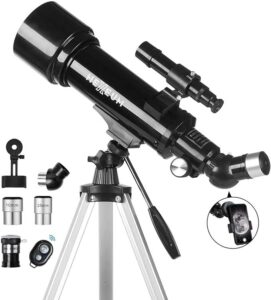
As one of the best telescopes for kids, the HEXEUM astronomical telescope features 500mm(f/7.1) focal length and 70mm aperture which provide stunning views while protecting your eyes.
This telescope delivers surprisingly good image clarity for its price range, making it suitable for observing the moon’s craters, bright planets, and basic terrestrial scenery during daytime use. Its lightweight design and simple assembly process are especially appealing to younger users and first-time stargazers who want a hassle-free experience.
Furthermore, the adjustable tripod offers decent stability on flat surfaces, though careful handling is still needed when viewing at higher magnifications.
Performance-wise, this telescope balances affordability and functionality rather well. The included eyepieces allow users to switch between wider sky views and closer observations of celestial objects. It also provides a satisfying learning platform for kids and casual users exploring space as a hobby.
Pros
- Easy to assemble and beginner-friendly
- Lightweight and portable design
- Good moon and planet viewing for entry-level use
- Includes useful accessories such as eyepieces and tripod
- Affordable price point for kids and casual learners
Cons
-
Image sharpness decreases at very high magnification
4) ToyerBee Telescope
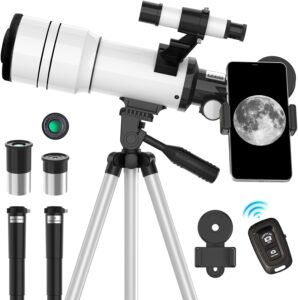
5) NASA Lunar Telescope for Kids – 90x Magnification
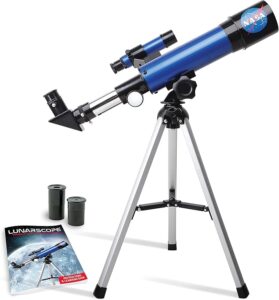
The National Aeronautics and Space Administration-branded Lunar Telescope for Kids with 90x magnification is designed to introduce young learners to basic stargazing and lunar observation.
This beginner-friendly telescope focuses on simplicity, durability, and educational value rather than professional astronomical performance. With 90x magnification, children get a closer look at the moon’s surface features, craters, and bright celestial objects under clear sky conditions.
Furthermore, the lightweight build and adjustable tripod make it easy for kids to set up and handle without requiring advanced technical knowledge. It also serves as a fun entry point into astronomy, encouraging curiosity about the night sky.
Optically, the telescope delivers decent clarity for its price range, especially when observing the moon and nearby bright objects. The included accessories are generally kid-safe and easy to assemble, making it suitable for beginners aged roughly 8–15 years.
Above all, the device performs best in low-light pollution areas and it is a good educational gift that balances affordability, usability, and basic astronomical learning.
Pros
- Beginner-friendly design suitable for kids
- Lightweight and portable construction
- 90x magnification good for moon observation
- Easy assembly with child-safe accessories
- Encourages interest in science and astronomy
Cons
- Requires steady mounting to avoid blur
6) HUGERSTAR Telescope
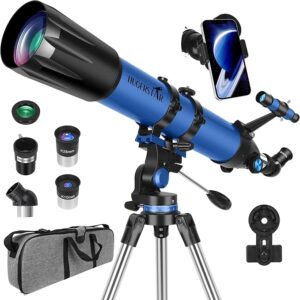
Next, we have the HUGERSTAR Telescope. It offers quick, no-tool assembly and 90% of users complete setup in under 10 minutes.
The clear instructions included make it beginner-friendly and perfect for exploring the cosmos at night and nature’s beauty by day, adding fun to every view.
Furthermore, the refractor design helps reduce maintenance since the optical tube is sealed, protecting internal components from dust and moisture.
Performance-wise, this telescope delivers respectable magnification when paired with the included eyepieces, allowing users to achieve sharp and reasonably contrast-rich images under good viewing conditions.
To top it all off, the build quality is solid enough for home astronomy use, and the tripod provides basic stability during observation sessions.
Pros
- 90mm aperture provides good light-gathering capability for its price range
- 800mm focal length supports decent planetary and lunar observation
- Refractor design requires minimal maintenance
- Suitable for beginners and intermediate hobbyists
- Comes with useful accessories for immediate setup
Cons
-
High magnification reduces image sharpness in poor atmospheric conditions
7) Dianfan Telescope
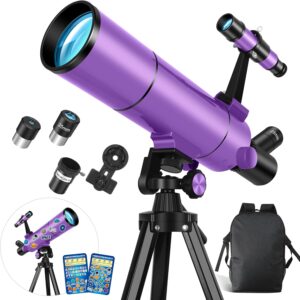
Lastly, we have the Dianfan Telescope for Kids & Adults. This is a versatile entry-level astronomical telescope designed to introduce beginners and young enthusiasts to stargazing.
Featuring an 80mm aperture and 500mm focal length, this telescope gathers a good amount of light, making it suitable for observing the moon, bright planets, and some deep-sky objects under favorable conditions.
The optical performance is generally clear for its price range, delivering reasonably sharp lunar surface details and recognizable planetary shapes. The telescope is also family-friendly, combining simplicity of use with decent magnification options that help kids and adults explore astronomy without complicated setup procedures.
Another feature that makes it one of the best telescopes for kids is the included accessories. It comes with accessories that support beginners, including eyepieces and a basic mounting system that helps stabilize viewing during observation. Assembly is also straightforward, and the lightweight design makes it easy to move the telescope between indoor and outdoor viewing locations.
Pros
- 80mm aperture offers decent light collection for beginner astronomy
- 500mm focal length provides balanced magnification for moon and planet viewing
- Easy setup suitable for kids and first-time users
- Lightweight and portable design
- Includes starter accessories for immediate use
Cons
- Not ideal for advanced or professional astronomical observation
- Limited performance for faint deep-sky objects
Key Factors to Consider when Choosing the Best Telescopes for Kids
1. Magnification and Objective Lens Size
Magnification determines how close distant objects appear, while the objective lens diameter controls how much light enters the telescope. For kids, a moderate magnification of about 20x–60x is ideal because extremely high magnification can make images blurry and difficult to stabilize. A larger objective lens improves brightness and clarity, especially when observing the Moon or bright planets.
2. Ease of Use and Setup
Next, a child-friendly telescope should be simple to assemble and operate. Look for models with straightforward alignment systems and intuitive controls that allow kids to start observing quickly without adult assistance.
3. Durability and Build Quality
The best telescopes for kids should be made from sturdy materials that withstand accidental bumps or rough handling. Lightweight but strong housings are preferable because they are easier for children to carry. Shock-resistant components and stable mounts are also important as they help protect internal optics from damage.
4. Mount Stability
Furthermore, a stable mount is essential for clear viewing because shaky supports cause image distortion. Tripod mounts are commonly recommended since they offer better balance and easier aiming. Adjustable height stands also allows children of different ages to use the telescope comfortably.
5. Optical Quality
Even though kids’ telescopes are beginner-level, decent optical quality is important for an enjoyable learning experience. Good optical lenses ensure sharp and accurate images of the night sky. Fully coated glass optics help reduce glare and improve contrast.
6. Portability and Weight
Children are more likely to use a telescope that is easy to move around. Lightweight designs encourage outdoor exploration and make it easier to carry the telescope to a viewing location. Compact models are especially suitable for backyard or camping observations.
7. Safety Features
Moreover, safety should be a priority when choosing the best telescopes for kids. Ensure the telescope includes protective lens caps and safe viewing instructions to prevent accidental eye exposure to bright sunlight. Parental supervision is recommended during daytime use.
8. Educational Value and Accessories
Lastly, the best telescopes for kids come with learning aids such as star maps, astronomy guides, or simple eyepiece options. Additional accessories like moon filters or extra lenses enhance the learning experience and keep children interested in astronomy as a hobby.
Read Also
Optional Add-Ons & Accessories
Kids enjoy stargazing even more by using these helpful accessories with their telescope:
-
Star charts or astronomy apps. This helps kids identify stars, planets, and constellations.
-
Smartphone adapters. A smartphone adapter allows children to attach a phone to the telescope to capture simple photos of the Moon or bright planets.
-
Moon filters. This accessory reduces Moon glare and helps reveal surface details like craters more clearly.
-
Portable red-light flashlights. A flashlight is essential for maintaining night vision while reading charts or moving around during stargazing.
Tips for First Time Stargazing
Stargazing for the first time is an exciting way to explore the night sky. Follow these tips to get the most our of your activity:
-
Find a dark viewing location. Go somewhere away from bright city lights for clearer sky visibility. Light pollution reduces the number of stars you can see.
-
Let your eyes adjust to darkness. Wait about 20–30 minutes without looking at bright screens so your vision adapts.
-
Start with simple objects. Focus on the Moon, bright stars, or planets before trying to locate faint objects.
-
Use a stargazing app or sky guide. Apps from sources like NASA can help you identify constellations and planets.
-
Learn a few constellations first. Don’t try to memorize the whole sky; pick 2–3 star patterns to start with.
-
Stay patient and observe quietly. Stars may appear slowly as your eyes adjust and your focus improves.
-
Bring basic tools if available. Binoculars are enough for beginners to complement the telescope.
Best Telescopes for Kids Care and Maintenance Tips
1.Handle with Care. Always carry the telescope by the base or mount, not by the optical tube or delicate parts.
2. Set Up on Stable Ground. Ensure the tripod is secure and level before observing to prevent falls or damage.
3. Use a Soft Cloth for Cleaning. Gently wipe lenses with a clean, soft microfiber cloth. Never use paper towels or tissue.
4. Avoid Touching the Glass. Fingerprints on lenses and mirrors reduce image clarity. Additionally, touching glass can damage the coatings.
5. Don’t Clean Unless Needed. Only clean optics if they are noticeably dirty; too much cleaning can wear coatings.
6. Store Dry and Dust-Free. After use, cover the telescope with a dust cap or store in a case to keep out dust and moisture.
7. Keep Accessories Together. Store eyepieces, finders, and filters in a dedicated box or padded pouch so they stay safe and organized.
8. Avoid Extreme Conditions, Last but not least, never leave the telescope in direct sun, heavy rain, or very cold temperatures.
FAQs
- What type of telescope is easiest for kids to use?
Refractor telescopes are usually the easiest for children because they require little maintenance and provide clear images of the Moon and bright stars.
- At what age can children start using a telescope?
Children around 8 years and older can begin using beginner telescopes with supervision. Simpler models help younger kids learn basic sky observation without frustration.
- What is the best magnification for a kid’s telescope?
For children, a magnification range of about 20x–60x is usually ideal. Very high magnification makes images shaky and harder to focus, which may frustrate young beginners.
Final Words
Hopefully, you have found this buying guide insightful and comprehensive. A telescope that fits a child’s needs well will make stargazing enjoyable and educational. Look at the attributes each telescope brings to the table and choose a model that has sturdy construction, clear optics, and child-friendly controls.