
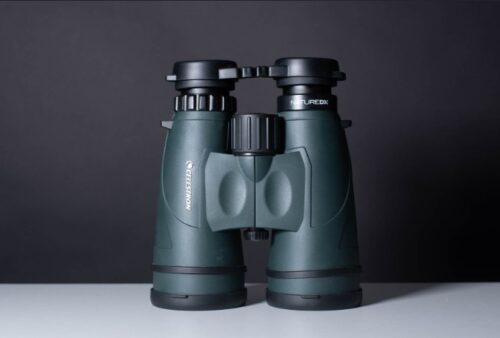
High-quality long-range binoculars help you see distant wildlife, landscapes, or stars more clearly without losing image stability or detail. In this buying guide, you’ll learn the key features to look for in the best binoculars for long distance, the advantages and disadvantages of different binocular types, and how to select a pair that matches your viewing needs and budget.
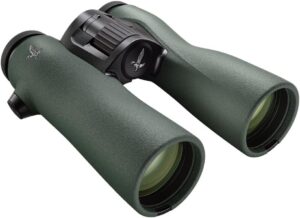
1. Swarovski NL Pure 12×42 Binoculars
2. Nikon Action Zoom 10-22×50 Binocular
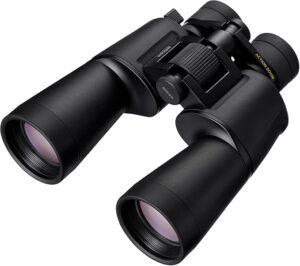
The Nikon Action Zoom 10-22×50 binocular is a versatile and powerful optic designed for users who need adjustable magnification in a wide range of outdoor scenarios.
With its 10–22x zoom capability, it allows you to smoothly transition from wide-area scanning to more focused, detailed observation. This makes it suitable for birdwatching, wildlife viewing, sports events, and general outdoor exploration.
Optically, the 50mm objective lenses gather a good amount of light, helping maintain image brightness even as magnification increases. Besides, Nikon’s optical coatings help enhance contrast and color fidelity, producing relatively sharp and clear images in daylight conditions.
Regarding handling, the ergonomic design offers a comfortable grip, and the central focus knob is responsive, allowing quick adjustments when tracking moving subjects.
In practical use, the binocular are solid and dependable, with a durable build that can handle regular outdoor handling. The field of view is also large for rapid target finding.
Pros
- Adjustable 10–22x zoom for flexible viewing
- Good light-gathering ability with 50mm lenses
- Clear and decent color reproduction in daylight
- Solid, durable build quality
- Comfortable grip and easy focusing system
Cons
- Image shake noticeable at high magnification
- Narrow field of view at 22x zoom
3. Celestron SkyMaster 25×70 Binoculars
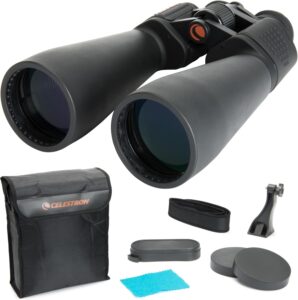
These are giant astronomy binoculars with massive 70mm objective lenses and 25x power. Pair them with any tripod for long-distance land-based viewing or astronomical observation.
Due to their size/weight and high magnification, most users mount SkyMaster binoculars on a traditional photo tripod bought separately. The built-in ¼”-20 adapter attaches to most tripods in seconds.
Regarding optical performance, the SkyMaster is a favorite among those who view in dim conditions near dawn and dusk or at night for astronomy. The BaK-4 prisms maximize light throughput to your eye so you see brighter, more detailed images.
Moreover, a rubber-armored housing protects your binoculars from damage and provides a secure gripping surface. The water-resistant exterior stands up to tough conditions and unexpected rainy weather.
Pros
- Very strong 25x magnification for long-distance viewing
- Large 70mm objective lenses provide bright, clear images
- Excellent for astronomy and night sky observation
- Multi-coated optics improve clarity and contrast
- Solid, durable build quality
- Tripod-adaptable for stable viewing
Cons
- Requires tripod for steady use due to high magnification
- Bulky
4. Vortex Triumph HD 12×50 Binoculars
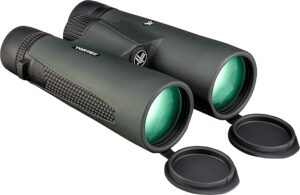
As one of the best binoculars for long distance, the Triumph HD delivers excellent image quality, ergonomics, and durability for its class.
With 12x magnification and 50mm objective lenses, they are built to pull in distant details clearly, making them especially useful for open terrain viewing, wildlife spotting, and long-range observation.
Furthermore, the HD optical system and fully multi-coated lenses work together to enhance light transmission, producing a bright and reasonably sharp image even in early morning or late evening conditions.
Moreover, the build quality also is solid, with a rubber-armored body that improves grip and helps the binoculars withstand outdoor use in rough conditions.
In real-world use, the 12x power is the striking feature. It allows you to see farther than typical 8x or 10x binoculars, though it does require steadier hands or support to get the best image stability. The focus wheel is smooth and easy to adjust, and the eye relief is comfortable enough for extended viewing sessions.
Pros
- Strong 12x magnification for long-distance viewing
- 50mm objective lenses provide good light gathering
- Clear, bright center image with decent color fidelity
- Durable, rubber-armored and weather-resistant build
- Comfortable eye relief and easy focusing system
- Good value for the performance level
Cons
- Noticeable image shake when handheld at 12x
5. FLYANT 20×50 High Powered Binoculars
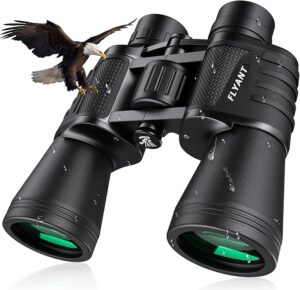
The FLYANT 20×50 High Powered Binoculars are the best budget binoculars for long-distance viewing.
With 20x magnification and a 50mm objective lens, they aim to deliver detailed views of distant objects such as wildlife, stadium events, landscapes, and even the night sky.
In real-world use, the binoculars offer a bright and wide field of view for their class, supported by multi-coated lenses and BAK4 prisms that help improve contrast and reduce glare.
The rubber-armored body also gives them a solid, outdoor-ready feel, making them suitable for hiking, travel, and casual observation.
Regarding overall experience, the FLYANT 20×50 strikes a good balance between affordability and performance. Users typically find the focus wheel smooth and easy to adjust, and the eye relief is comfortable for short to medium viewing sessions.
Pros
- Strong 20x magnification for long-distance viewing
- BAK4 prisms and multi-coated lenses improve clarity and contrast
- Rubber-armored body offers a secure grip and basic shock resistance
- Easy-to-use central focus wheel
- Lightweight and portable for travel and outdoor activities
- Good value for beginners and casual users
Cons
- High magnification causes image shake when handheld
6. FREE SOLDIER 20×50 Binoculars
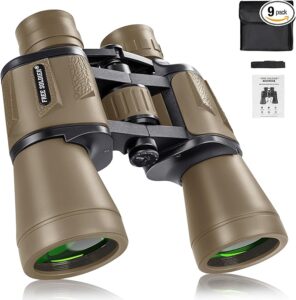
The Free Soldier binoculars for adults have 20X power magnification, 50mm large objective lens, and a large field of view of 1000 yards that makes them good for fast-moving subjects.
They are easy to operate binoculars for adults and kids, and perfect for bird watching, hunting, travel, opera, concert, sports games, safari
With professional optics, these compact binoculars are adopted by BAK4 Porro Prism. They provide 99.8% light transmission and improves color reproduction. The green FMC anti-reflective coating reduces the reflected light in the objective lens and improves light transmission, image brightness, and image sharpness
Furthermore, these high-powered binoculars for adults feature 28mm large eyepieces that deliver a clearer, full-size image with generous eye relief perfect for extended viewing comfort. Additionally, the 50mm lenses are larger to give lots of light-gathering power in low light.
Pros
- Strong 20x magnification for long-distance viewing
- Large 50mm objective lenses improve light gathering in daylight
- Durable rubber-armored design for outdoor use
- Comfortable grip and solid build feel
- Simple and easy-to-use focus system
- Suitable for multiple outdoor activities like birding, hiking, and sports
Cons
- Image shake is noticeable at 20x magnification without stabilization
7. Sogries 10-30×50 Zoom Binoculars
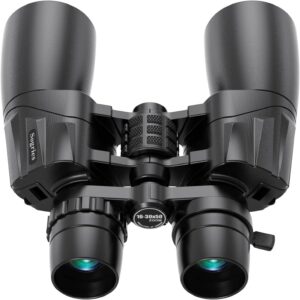
The Sogries 10-30×50 Zoom Binoculars are the next recommendation for the best binoculars for long distance.
Designed for users who want flexible magnification in a single device, they are suitable for activities like bird watching, hiking, sports viewing, and general outdoor observation.
The 10-30x zoom range allows you to start with a wider field of view at lower magnification and gradually zoom in for more detailed viewing of distant subjects. T
Furthermore, the 50mm objective lenses help gather a decent amount of light, improving brightness in daytime conditions and making images clearer in open environments.
Regarding the build, these binoculars are solid, with a focus on portability and ease of handling, though at higher zoom levels some image shake becomes noticeable without stabilization support.
At lower magnification, the view is generally sharp and easy to scan, while at higher zoom (20x–30x), users may notice reduced sharpness and a narrower field of view, which is common in budget zoom binoculars. Eye comfort is moderate, and adjustments like focusing and zoom control are straightforward, making them beginner-friendly.
Overall, they offer good versatility for casual outdoor users who want a single binocular for multiple distances rather than specialized high-end optics.
Pros
- Adjustable 10–30x zoom for versatile viewing distances
- 50mm objective lenses provide decent brightness in daylight
- Easy-to-use focus and zoom controls
- Suitable for multiple activities
- Budget-friendly option for beginners
Cons
- Image shake increases significantly at high magnification
8. IBQ 12×50 UHD Binoculars
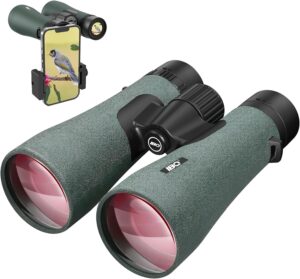
Last, but importantly not least is the IBQ 12×50 UHD Binoculars. These versatile binoculars are designed for users seeking strong magnification combined with a relatively large objective lens for improved light gathering.
With a 12x zoom, they bring distant subjects significantly closer, making them suitable for wildlife observation, outdoor sports, and long-range viewing.
Optically, the 50mm objective lenses help maintain brightness in low-light conditions such as early morning or late evening, while UHD (Ultra High Definition) optics aim to improve clarity, color accuracy, and overall sharpness.
Furthermore, the multi-coated lenses reduce glare and enhance contrast, giving a more detailed view compared to basic entry-level binoculars.
The field of view is adequate for tracking moving subjects, but not as wide as lower magnification models, which is a common trade-off for higher zoom power.
Above all, the overall build emphasizes durability, with a rubberized exterior for grip and protection against minor impacts and outdoor conditions.
Pros
- Strong 12x magnification for long-distance viewing
- Large 50mm lenses provide good light transmission
- UHD optics improve clarity and color detail
- Suitable for wildlife, sports, and astronomy use
- Rubberized body improves grip and durability
- Works well in low-light conditions
Cons
- Noticeable hand shake at 12x magnification
Related:
Criteria for Choosing the Best Binoculars for Long Distance
Choosing the best binoculars for long distance viewing requires balancing magnification, clarity, stability, and brightness, rather than just going for the highest zoom. Consider these factors in your selection process:
Magnification Power
For long-distance viewing, most experts recommend 10x to 12x magnification. This range offers a good balance between detail and stability. Higher magnification (15x and above) can show more detail but often requires a tripod or stabilization because even small hand movements become very noticeable.
Objective Lens Size (42mm–50mm for Brightness)
The objective lens controls how much light enters the binoculars. Larger lenses like 42mm or 50mm produce brighter, clearer images, especially in low light such as dawn or dusk. However, bigger lenses also make binoculars heavier, so you need to balance brightness with portability.
Optical Quality and Glass Type
Next, high-quality glass such as ED or fully multi-coated lenses reduces glare, improves contrast, and enhances sharpness. Better optics make a huge difference when viewing objects at long distances, where poor-quality lenses often produce blurry or washed-out images.
Field of View (FOV)
A wider field of view makes it easier to locate and track moving objects like birds or animals. Long-distance binoculars with very high magnification usually have a narrower FOV, which makes it harder to follow fast-moving subjects.
Stability and Image Shake Control
At long range, even slight shaking can blur the image. As a result, the best binoculars for long distance should be comfortable to hold or consider models compatible with a tripod or image stabilization. Stability is often just as important as magnification for clear viewing.
Build Quality and Durability
Since long-distance binoculars are often used outdoors, features like waterproofing, fog resistance, and rubber armor are important. These protect the optics from weather changes, accidental drops, and rough handling.
Weight and Portability
Powerful binoculars become heavy quickly, especially with large lenses. If you plan to carry them for long periods, choose a lightweight model that still offers good optical performance to avoid fatigue during use. This will ensure ease of use, especially lengthy glassing sessions.
Low-Light Performance
Lastly, the best binoculars for long distance use should perform well in dim conditions. Features like larger objective lenses and high-quality coatings help maintain brightness and clarity when light levels drop, such as in forests or at sunset.
Tips for Better Long-Distance Viewing
- Use a steady grip by holding the binoculars close to your face and bracing your elbows against your body
- Rest your arms on a solid surface or use a tripod for high-magnification binoculars to reduce shake
- Adjust the eyecups properly to match your eye position, especially if you wear glasses
- Focus slowly and precisely using the central focus wheel to achieve the sharpest image
- Start by locating the subject at a lower magnification before zooming in for a clearer view
- Choose stable viewing conditions with minimal heat haze, wind, or atmospheric distortion
- View during early morning or late afternoon when light is softer and visibility is better
- Keep both eyes relaxed to avoid strain and maintain a comfortable viewing experience
- Clean lenses regularly to ensure maximum clarity and prevent image distortion
- Practice scanning slowly across the horizon instead of quick movements to avoid losing focus
FAQs
- What magnification is best for long-distance binoculars?
For most users, 10x to 12x magnification is ideal. It provides a strong balance between clear detail and image stability without excessive shaking.
- Are higher magnification binoculars always better?
Not necessarily. While higher magnification (15x and above) shows more detail, it often reduces stability and brightness, making the image harder to keep steady without a tripod.
- Do I need a tripod for long-distance binoculars?
Yes. A tripod is recommended for binoculars above 12x magnification. It helps reduce hand shake and improves image clarity during long viewing sessions.
- Can I use long-distance binoculars at night?
Yes, but only in low-light environments like dusk or moonlight. Standard binoculars are not designed for full night vision unless they are specialized night-vision models.
Conclusion
The best binoculars for long distance viewing are not just about maximum zoom, but about clear optics, steady viewing, good light transmission, and practical usability. A balanced 10x–12x model with strong glass quality and a 42mm–50mm lens is usually the most reliable choice for most users.