
2) Leofoto Professional Camera Tripod – Best Durable

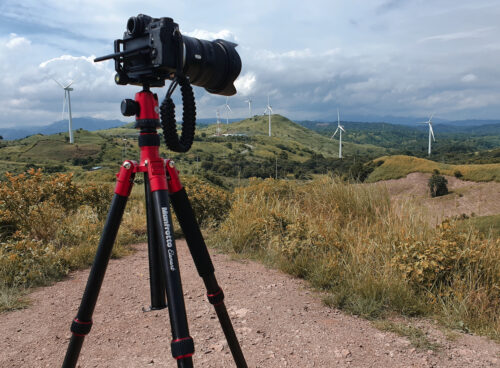
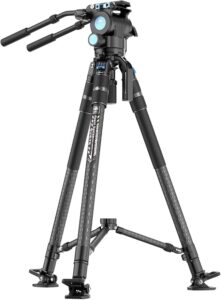
Next, we have the LEOFOTO Carbon Fiber Lightweight Travel Tripod. This tripod features a 32mm max tube, weighs 1.4kg/3.09lb and has a maximum weight capacity of 15kg/33.07lb.
The selling point of this tripod is lightweight construction. Crafted from high-quality carbon fiber, it offers an impressive balance between lightness and strength, making it ideal for travel, hiking, or urban photography.
Furthermore, the sleek design allows for quick setup and adjustment, while the durable locking mechanisms ensure that your camera remains secure at all times. The tripod also features adjustable leg angles and a versatile center column, giving users the flexibility to shoot from low or high perspectives effortlessly.
Beyond functionality, the LEOFOTO tripod delivers smooth performance with minimal vibration, even on uneven terrain. The rubber feet and optional spikes provide extra grip for outdoor shoots, while the carbon fiber construction dampens resonance, resulting in sharper images.
Above all, portability is further enhanced by its foldable design, which fits easily into backpacks or carry-on luggage.
Pros
- Lightweight yet highly durable carbon fiber construction
- Compact and foldable for easy travel
- Supports a wide range of camera sizes and weights
- Adjustable leg angles and versatile center column for flexibility
- Minimal vibration for sharper images
Cons
-
Higher price point compared to aluminum alternatives
3) Peak Design Travel Tripod – Best for the Money
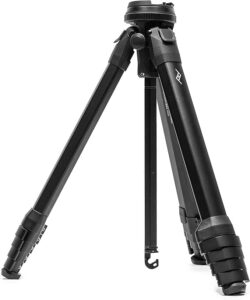
The Peak Design Travel Tripod in aluminum is a masterclass in compact engineering. It is designed for photographers who value portability without sacrificing stability.
The sleek, minimalist design allows the tripod to collapse into a remarkably small package, making it ideal for travel, hiking, or urban photography. Despite its compact size, it extends smoothly to provide a solid, stable base for cameras of various sizes.
Regarding construction, the aluminum build strikes a balance between lightweight portability and durability, giving users confidence that it can withstand the rigors of frequent travel. Furthermore, the versatile ball head and integrated leg locks make setup and adjustments fast and intuitive, while the tripod’s design allows it to maintain stability even on uneven terrain.
In practical use, this travel tripod excels at versatility and convenience. Its quick setup mechanism and smooth leg extension make it easy to switch between different shooting angles and heights. Moreover, its able to hold heavier DSLR and mirrorless cameras securely, while the compact form fits easily into backpacks or carry-on luggage.
Pros
- Extremely compact and travel-friendly design
- Stable and durable aluminum construction
- Smooth leg extension and quick setup
- Versatile ball head with easy adjustments
- Can hold a range of camera sizes securely
Cons
-
Limited maximum height for taller users without extension
4) NEEWER LITETRIP LT32 62″ Travel Tripod Carbon Fiber – Best Compact
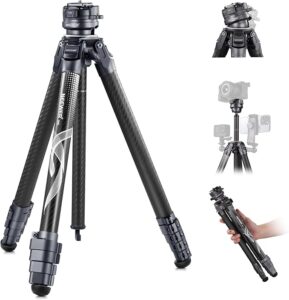
As one of the best travel tripods for photography, the NEEWER LITETRIP LT32 62″ Travel Tripod impresses with its blend of lightweight design and professional-grade functionality.
Crafted from carbon fiber, this tripod strikes a balance between strength and portability, making it ideal for photographers who frequently travel.
During use, it extends to a maximum height of 62 inches, offering flexible shooting perspectives, while the detachable center axis allows for low-angle photography or tabletop setups. Additionally, the fast flip buckles simplify setup and adjustment, allowing users to move from one location to another with minimal hassle.
Furthermore, the ±15° leveling feature and 360° panoramic head provide precise framing and smooth rotational shots, which is particularly useful for landscape, architectural, or panoramic photography. .
Beyond its practical features, the tripod’s compatibility with Arca-style quick release plates ensures that it integrates seamlessly with a wide range of cameras and accessories. Besides, the construction is sturdy yet surprisingly lightweight, making it comfortable to carry over long distances without compromising stability.
Pros
- Lightweight carbon fiber construction for easy transport
- Extends up to 62 inches for versatile shooting angles
- ±15° leveling and 360° panoramic head for precise framing
- Detachable center axis for low-angle shots
- Fast flip buckles for quick setup
- Arca-style quick release plate compatible
Cons
- The carbon fiber is less susceptible to scratches if not handled carefully
5) K&F CONCEPT 64″ Carbon Fiber Camera Tripod – Best Budget
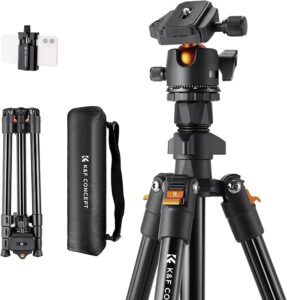
If you are looking for the best budget tripod for travel photography, the K&F CONCEPT 64-inch camera tripod is hard to beat. It is a versatile, lightweight, and affordable option for photographers who are always on the move.
Designed for travel and outdoor use, it extends up to an impressive 163 cm, providing stable support for DSLRs, mirrorless cameras, and even heavier setups up to 17.6 lbs (8 kg). Its 360-degree ball head allows for smooth and precise adjustments, making it easy to capture both panoramic shots and dynamic angles.
Despite its large maximum height, the tripod remains compact and easy to carry, with quick-release leg locks that make setup and takedown efficient, even in outdoor conditions. It also comes with a standard 1/4” thread which can be applied to most Arca-Swiss quick release plates.
Durability and stability are other notable strengths of this tripod. Constructed from high-quality aluminum alloy, it withstands rough outdoor use while maintaining a lightweight profile. Additionally, the rubberized feet provide additional grip on various terrains, preventing accidental slips during shoots.
To top it all off, the tripod also offers multiple leg angle options, allowing users to position their camera close to the ground or at standard shooting height.
Pros
- Lightweight and portable for travel
- Supports heavy cameras up to 17.6 lbs (8 kg)
- 360-degree ball head for versatile shooting angles
- Durable aluminum alloy construction
- Adjustable leg angles and rubberized feet for stability
Cons
- The ball head feels less smooth under very heavy loads
- No built-in bubble level for precise alignment
6) Benro Mammoth Carbon Fiber Tripod – Best for Professionals

The Benro Mammoth Carbon Fiber Tripod – 4-Section Heavy-Duty Carbon Fiber Tripod with 75 mm Bowl is designed for professional photographers and videographers looking for a stable and reliable platform for heavy camera gear.
Constructed from high-quality carbon fiber, this tripod combines strength with a surprisingly lightweight design, making it easier to transport without compromising durability.
To complement the sturdy durability, its 4-section leg design allows for compact storage while providing a maximum height suitable for a variety of shooting angles. Furthermore, the 75 mm bowl makes it ideal for fluid heads, providing smooth and precise pan and tilt movements for video work, while the robust leg locks ensure stability on uneven terrain.
The tripod also features retractable spikes for added grip in outdoor environments, making it versatile for both studio and field use.
Pros
- Extremely stable and durable, ideal for heavy cameras
- Lightweight carbon fiber construction for easier transport
- Smooth pan and tilt with 75 mm bowl compatibility
- Compact 4-section design for convenient storage
- Retractable spikes for enhanced outdoor stability
Cons
- Heavier than smaller tripods
- Premium price
7) FALCAM TreeRoot Lite F38 Quick Lock Carbon Fiber Travel Tripod – Best Versatile
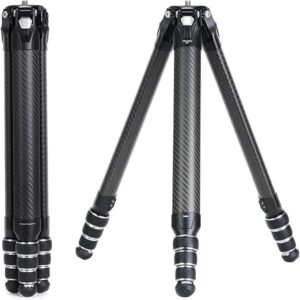
Next, we have the Falcam TreeRoot F38 Pro Carbon Fiber Tripod. This 61′” tripod supports horizontal and vertical shooting with adjustable damping. The tactile locking knobs ensure precise ball head control, even in low-light conditions.
The most notable feature of this tripod is the F38 Pro Quick Release Compatibility. It is compatible with 90% of Arca-Swiss plates and one-step locking mechanism enables direct camera mounting, even without tripod deployment.
Furthermore, the abundant expansion interfaces feature F22 quick-release interfaces, 1/4″ Arri threaded holes, carry strap holes, and Maglink buckle compatibility for versatile accessory mounting.
What’s more, the all-terrain trident foot pegs provide stable support on various surfaces while protecting sensitive floorings like tiles and wood. After removing the rubber footpads, the three-pronged spikes ensure stable footing on soft carpets or ice interfaces.
In addition to everything else, this tripod features an innovative butterfly latch design. This design allows tool-free removal for effortless low-angle shooting, enabling smooth and creative photography transitions.
Pros
- Lightweight yet strong carbon fiber construction
- Supports up to 5kg load
- Maximum height of 61 inches for versatile shooting angles
- Quick-lock travel design for fast setup
- Compatible with F22 interfaces and various accessories
- Compact and portable for travel
Cons
-
Slightly higher price compared to aluminum tripods
8) FreeSea 72 inch Camera Tripod – Best for Beginners
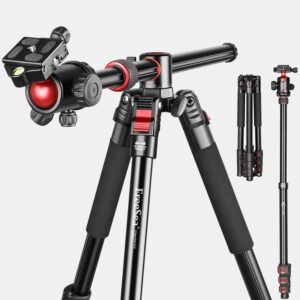
The FreeSea 72-inch Camera Tripod is our last recommendation for the best travel tripods for photography. It offers an impressive combination of versatility and stability, making it ideal for both amateur and professional photographers.
Its two-section transverse center column allows movement from 0 to 180 degrees and can rotate 360° horizontally, making panorama shooting effortless.
Furthermore, the tripod’s 5-section legs, equipped with quick-release flip-locks, enable rapid height adjustments from 22.4 inches to 72 inches, while three-level leg angle adjustments ensure stability on uneven terrain. .
Adding to its flexibility, the tripod can be quickly converted into a monopod by detaching the central column, allowing for more dynamic and mobile shooting. Moreover, the 36mm ball head rotates a full 360°, offering complete freedom in framing and capturing unique perspectives.
Despite its sturdy construction supporting up to 33 lbs, the tripod remains lightweight at just 3.7 lbs and folds down to a compact 16.93 inches for easy transport.
Pros
- Central column rotates 360° for panorama and unique angles
- Quick height adjustments from 22.4″ to 72″ with flip-lock legs
- Converts easily into a monopod
- 36mm ball head allows full 360° rotation
- Lightweight yet supports up to 33 lbs
- Folds compactly for easy portability
Cons
- Small ball head for heavy professional camera setups
- The flip-lock legs require occasional tightening for long-term stability
Criteria for Choosing the Best Travel Tripods for Photography
Whether you’re capturing sweeping landscapes, urban scenes, or detailed close-ups, here are seven key criteria to consider when selecting the best travel tripod for photography.
Weight and Portability
Firstly, weight and portability are crucial factors for a travel tripod. A lightweight tripod allows for easy transport during hikes, city tours, or long trips without adding unnecessary strain. Carbon fiber models are often preferred for their strength-to-weight ratio, while aluminum tripods offer durability at a slightly higher weight. Additionally, the tripod should fold compactly to fit comfortably in your luggage or backpack.
Load Capacity
A tripod’s load capacity determines the maximum weight it can safely support, including your camera, lenses, and accessories. Choosing a tripod with a higher load capacity than your current setup ensures stability and leaves room for future equipment upgrades.
Height Range
Next, consider height range. This feature affects the versatility of your shots. The best travel tripods for photography should extend high enough for standing or eye-level photography while also allowing for low-angle or macro shots. Additionally, it should collapse to a compact size for travel. A tripod that balances both extremes will adapt to a variety of shooting scenarios.
Stability and Build Quality
Furthermore, stability is essential for sharp, professional images. Tripods made from high-quality materials with strong legs, secure locking mechanisms, and anti-slip feet provide reliable performance even on uneven terrain or windy conditions. Moreover, stability ensures that your camera stays steady for long exposures and precise framing.
Leg Locks and Adjustability
The design of the leg locks affects setup speed and convenience. Twist locks and flip locks are the most common, each offering quick adjustments and secure positioning. Additionally, multi-angle leg adjustments allow you to shoot on uneven surfaces or achieve creative low-angle perspectives without compromising stability.
Head Type and Compatibility
It is also important to consider head type and compatibility. The head of the best travel tripods for photography impacts how smoothly you can position your camera. Ball heads are compact and versatile for travel, while pan-tilt heads offer precise control for detailed framing. Ensure that the head is compatible with your camera and can support its weight. Some tripods feature detachable heads for greater flexibility and convenience.
Additional Features
Last but not least, extra features go a long way to enhance the tripod’s functionality. Look for removable center columns for macro photography, hooks to add weight for stability, built-in spirit levels, and weather-resistant materials. Collapsible designs and carrying cases further improve portability, making your tripod more practical for frequent travel.
Travel Tips for Photography Tripods
1. Match capacity to your heaviest camera. Choose a tripod that can safely support your camera and largest lens to avoid wobbling or damage.
2. Check folded size and weight. Ensure the tripod is compact and light enough for easy transport during trips.
3. Consider leg locks. Twist locks are sleek while flip locks are quick. Pick based on how fast you need to set up.
4. Adjustable legs for uneven terrain. Tripod legs that adjust independently help stabilize shots on rocky or sloped surfaces.
5. Balance portability and stability. Consider the environments where you’ll primarily use your tripod. If you’ll mostly be traveling through cities or flat terrain, a lighter, more portable tripod is ideal.
Related
How to Maintain the Best Travel Tripods for Photography
- Regular Cleaning: Wipe down the tripod after each use with a soft, dry cloth to remove dust, dirt, or moisture.
- Protect Leg Locks: Prevent sand, grit, or debris from entering twist or flip locks, as they cause jamming or reduce smooth operation.
- Check Screws and Joints: Periodically tighten screws, bolts, and joints to maintain stability and prevent wobbling.
- Dry Storage: Store the tripod in a cool, dry place to prevent rust or corrosion, especially for metal parts.
- Protective Bag: Use a tripod bag or case during travel to reduce exposure to dust, moisture, or physical damage.
- Inspect for Wear: Regularly examine rubber feet, leg tips, and locking mechanisms for wear and replace parts as needed to ensure safe use.
FAQs
- Should I choose carbon fiber or aluminum for a travel tripod?
It depends on your budget and preference. Carbon fiber tripods are lighter and more resistant to vibration, making them ideal for hiking and travel. Aluminum tripods are slightly heavier but more affordable and durable in rugged conditions.
- Are compact tripods stable enough for long exposures?
Yes. Many modern travel tripods are designed for stability despite their compact size. Carbon fiber models with good leg locks and rubber or spiked feet provide excellent stability for long exposures.
- What type of tripod head is best for travel photography?
Ball heads. They are often preferred for travel due to their compact size and quick adjustment capabilities. Pan-tilt heads offer more precise control but are bulkier. Choose based on your shooting style.
Final Words
Hopefully, you have found this buying guide insightful and thorough. Choosing the best travel tripod for photography is essential for capturing sharp, professional-quality photos on the go. By considering factors like weight, stability, load capacity, and versatility, you will find a tripod that fits your shooting style and travel needs.