
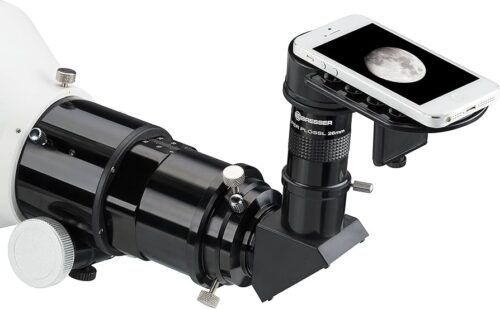
Best Telescope Phone Adapters
1. Celestron – NexYZ DX
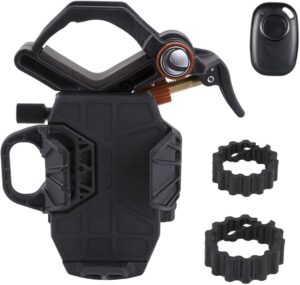
The Celestron NexYZ DX Universal Smartphone Adapter is the best telescope phone adapter. It is a premium digiscoping accessory designed for users who want a stable, precise way to capture photos and videos through telescopes, spotting scopes, and binoculars.
Built with a durable metal frame and reinforced polymer components, the NexYZ DX is solid and dependable even during extended outdoor use.
Another notable feature is the advanced three-axis alignment system. It allows for smooth, independent adjustment of the X, Y, and Z axes, making it easier to center a smartphone camera over the eyepiece with impressive accuracy.
Furthermore, the adapter accommodates a wide range of smartphones, including larger and heavier models, while the strong clamping mechanism ensures the phone remains secure during observation and recording.
In real-world use, the NexYZ DX excels in stability and ease of fine-tuning, making it ideal for birdwatching, wildlife observation, and long-range viewing not just astronomy. Additionally, the twist-lock eyepiece clamp provides a firm grip on most eyepieces, reducing vibration and helping maintain image clarity, even at higher magnifications.
Once properly aligned, the adapter holds its position well, allowing users to quickly switch between viewing and capturing moments without constant readjustment.
Pros
- Sturdy metal construction with premium feel
- Highly precise three-axis alignment system
- Secure grip for larger and heavier smartphones
- Compatible with a wide range of optics and eyepiece sizes
- Excellent stability for photography and video
Cons
-
Bulkier and heavier than basic smartphone adapters
2. Tridaptor – Universal Digiscoping Adapter
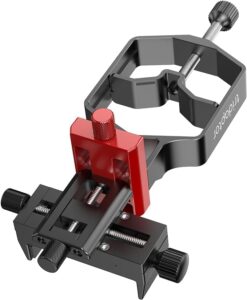
The Tridaptor Universal Digiscoping Adapter is designed to make smartphone digiscoping simple, stable, and highly accessible for both beginners and experienced outdoor enthusiasts.
Built with a rugged yet lightweight frame, the adapter securely mounts most smartphones to binoculars, spotting scopes, monoculars, and telescopes. Besides, its adjustable clamping system accommodates a wide range of phone sizes, while the precision alignment mechanism ensures the phone’s camera lens lines up accurately with the optic’s eyepiece.
Once properly aligned, the adapter holds firm, minimizing vignetting and allowing users to capture sharp photos and smooth videos of distant wildlife, birds, or landscapes.
In practical use, it impresses with ease of setup and dependable stability in the field. The non-slip rubberized contact points protect both the phone and optics from scratches while enhancing grip, even during extended viewing sessions. The adapter also performs well in outdoor conditions, maintaining alignment when panning or tracking moving subjects.
Pros
- Universal compatibility with most smartphones and optics
- Sturdy construction with good vibration control
- Adjustable alignment for reduced vignetting
- Non-slip, scratch-protective contact surfaces
- Lightweight and portable for field use
Cons
-
The initial alignment takes time for first-time users
3. SVBONY SV214 Pro Universal Phone Adapter
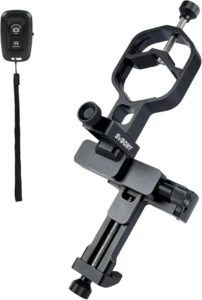
The SVBONY SV214 Pro Universal Phone Adapter is a versatile and well-built accessory designed to help users capture clear images and steady videos through telescopes, spotting scopes, and binoculars using a smartphone.
The selling point of this accessory is its build quality. It is solid and thoughtfully engineered with sturdy clamps to hold your phone securely in place.
Setup is straightforward: adjust the clamps to fit your phone, align the eyepiece with the adapter’s lens opening, and tighten the knobs to lock everything in place.
In practical use, the adapter’s grip and stability make a noticeable difference, especially when paired with a tripod or stable mount. Photos through optics come out well-aligned, and the cushioned clamps protect your phone from scratches.
Above all, it is universal and compatible with almost any brand/model of iPhone/Android smartphone (width 55-105mm).
Pros
- Easy to set up and adjust
- Solid build quality with secure clamps
- Works with a wide range of phone sizes and optics
- Helps improve image stability and alignment
- Great value for people getting into digiscoping
Cons
-
Takes some trial and error to align perfectly at first
4. APEXEL 360° Telescope Phone Adapter
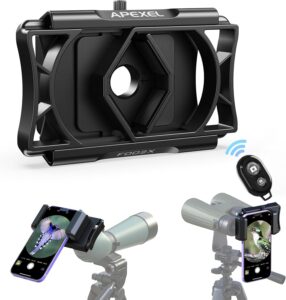
As one of the best telescope phone adapters, the APEXEL 360° Telescope Phone Adapter is a versatile and practical accessory for anyone looking to capture high-quality images and videos through their telescope.
Its selling point is the full 360-degree rotation. This feature allows you to easily adjust the angle and orientation of your smartphone without having to reposition your optical device.
The adapter’s construction is solid and durable, made from high-quality metal and plastic components, ensuring it holds your phone securely without wobbling. Installation is straightforward, and it fits most smartphones, offering a hassle-free way to link your device to optical gear.
In use, the APEXEL adapter delivers reliable stability and consistent results. Its adjustable clamps accommodate various phone sizes, and the padding protects your device from scratches while maintaining a firm grip.
Whether you’re capturing images of the moon, birds, or distant landscapes, the adapter ensures clear and well-aligned shots.
Pros
- Full 360° rotation for flexible shooting angles
- Compatible with most smartphones
- Sturdy construction ensures secure phone attachment
- Easy installation and adjustment
- Protects phone from scratches with padded clamps
Cons
-
Require careful balancing with heavier phones
5. Celticbird Smartphone Scope Adapter
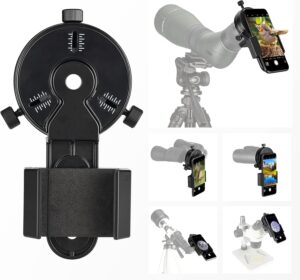
Next, we have the Celticbird Smartphone Scope Adapter.
This universal phone scope adapter mount is suitable for eyepieces with 34mm-62mm(1.34”-2.44”) outer diameter and works with binoculars, monocular, telescopes, spotting scopes, and microscopes.
Its adjustable design allows it to fit a wide range of smartphone sizes and optical devices, ensuring a secure attachment without the risk of slipping. Furthermore, the adapter is made of durable materials that provide stability and long-lasting use.
The precise alignment mechanism helps you achieve sharp, clear photos and videos straight through your optics. For birdwatchers, stargazers, or wildlife enthusiasts, this adapter eliminates the hassle of shaky images, making it easier to capture fine details from a distance.
For added convenience, installation and usage are straightforward, even for beginners. The adapter’s quick-release mechanism allows for easy mounting and removal, and the 360-degree rotation feature ensures you can adjust your phone for perfect framing.
To top it all off, this accessory adds a distance adjustment function between the eyepiece and the lens to capture a clearer picture and its lightweight design makes it portable, so you can carry it alongside your optics without added bulk.
Pros
- Adjustable design fits most smartphones and optics
- Durable construction ensures stability and long-term use
- Quick-release and easy installation
- 360-degree rotation for precise framing
- Lightweight and portable
Cons
-
Best results with phones that have rear cameras centered
6. Three Triping 3-Axis Spotting Scope Phone Adapter and Telescope Phone Mount
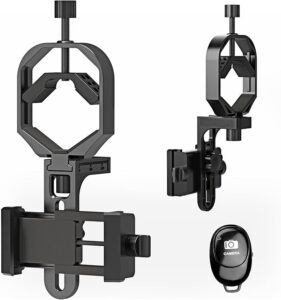
If you are looking for a universal telescope phone adapter that is easy to mount, look no further than the Three Triping 3-Axis Spotting Scope Phone Adapter and Telescope Phone Mount
It is engineered with vertical, horizontal and depth alignment to precisely match your phone camera to the eyepiece, delivering a full image with reduced distortion or shadowing.
Furthermore, this adapter offers fine distance control for optimal eye relief and focus accuracy. The depth-adjust slider allows micro-adjustments between the lens and eyepiece, helping you instantly find the sharpest point of focus.
The universal Ø30–57 mm eyepiece is compatible with spotting scopes, telescopes, binoculars, monoculars and microscope. This eliminates the need for different mount sizes and ensures a solid grip on both large and compact eyepieces.
Furthermore, the secure phone clamp supports most smartphones including iPhone 17/16/15 series, Samsung S24/S23 Ultra, Google Pixel and more. The wide clamp holds the phone firmly even with thicker protective cases and the integrated 1/4″-20 threaded port allows quick mounting to tripods or stands.
Pros
- 3-axis adjustment allows precise alignment for better image quality
- Universal compatibility with most smartphones and optical devices
- Lightweight yet durable construction for outdoor use
- Secure grip prevents phone from slipping during shooting
- Easy to install and remove
Cons
-
Initial calibration takes some time
7. Magsafe Digiscoping Adapter
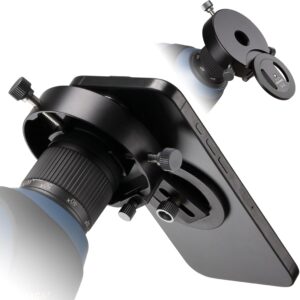
Last but not least, we have the Magsafe Digiscoping Adapter. This is versatile tool designed for birdwatchers, astronomers, and wildlife enthusiasts who want to capture clear images through their telescopes or spotting scopes.
As one of the best telescope phone adapters, its compatibility with eyepieces up to 2.5 inches makes it suitable for a wide range of optical devices, providing a secure and stable connection between your smartphone and scope.
The adapter uses a magnetic attachment system that simplifies setup, allowing users to align their phone camera quickly without fiddling with screws or clamps. This design also ensures minimal vibration, which is crucial for sharp, detailed shots of distant subjects.
Furthermore, the lightweight construction means it won’t add unnecessary bulk to your gear, making it convenient for field use. This adapter also boats an adjustable fit to accommodate different phone sizes, while the magnetic system ensures the device stays in place even during minor movements or uneven terrain.
Pros
- Easy magnetic attachment for quick setup
- Compatible with eyepieces up to 2.5 inches
- Lightweight and portable design
- Provides stable alignment for sharp images
- Adjustable to fit various smartphone sizes
Cons
- Limited to smaller eyepieces and may not fit large telescopes
Read Also
- 7 Best Binocular Tripod Adapters
- 7 Best Night Vision Binoculars for Stargazing
- 7 Best Digiscoping Adapters for Spotting Scopes
Key Factors to Consider when Choosing the Best Telescope Phone Adapter
Compatibility
The first factor to consider when choosing a telescope phone adapter is compatibility. Not every adapter fits all telescope models or smartphones, so it’s essential to check that the adapter can securely attach to your specific telescope eyepiece and align properly with your phone’s camera. Using an incompatible adapter can lead to poor image quality or even make it impossible to use your phone for astrophotography.
Stability and Build Quality
Next, stability is crucial for capturing clear images. A well-built, sturdy adapter keeps your phone steady and aligned with the eyepiece, reducing the chances of shaking or misalignment. Adapters made from high-quality materials like metal or reinforced plastic generally provide better stability and durability than cheaper, flimsy models.
Ease of Installation and Adjustment
The best telescope phone adapters should be easy to install and adjust, especially for beginners. Adapters with simple clamps, adjustable knobs, or quick-release mechanisms save time and effort while allowing precise alignment of your phone with the telescope. Avoid complicated setups that frustrate users and make astrophotography less enjoyable.
Optical Alignment
Furthermore, proper optical alignment ensures that your phone camera sits perfectly in line with the telescope eyepiece. Misalignment often results in dark corners, blurry edges, or distorted images. Choosing an adapter that allows fine-tuning alignment is important for capturing clear, professional-looking photos.
Versatility
Versatility is another important factor. If you plan to use the adapter with multiple telescopes or different smartphones, a flexible design that accommodates various sizes and types is ideal. This not only saves money but also makes the adapter more practical for different setups.
Durability and Materials
The materials and durability of the best telescope phone adapters determine how long it will last. High-quality metals or reinforced plastics can withstand frequent handling, outdoor conditions, and long observation sessions better than low-quality materials. Investing in a durable adapter ensures reliable performance over time.
Portability and Weight
For Astro photographers who travel to dark-sky locations, portability matters. Lightweight, compact adapters are easier to carry and pack along with your telescope and other gear. Bulky or heavy adapters can be cumbersome, especially when hiking or moving between observation sites.
Price versus Value
Last but not least, consider the price in relation to the value it offers. While higher-end adapters are often more expensive, they usually provide better stability, precision, and long-term reliability. Evaluating the balance between cost and quality helps you choose an adapter that meets your needs without overspending.
Tips for Best Results with a Telescope Phone Adapter
1. Use a Stable Mount or Tripod. Even the best adapter can’t prevent blurry images if your telescope or phone shakes. Always use a sturdy tripod or telescope mount to keep your setup steady, especially for long-exposure shots of stars or planets.
2. Align Your Phone Carefully. Take your time to adjust the phone’s camera lens so it’s perfectly aligned with the telescope eyepiece. Small adjustments make a big difference as misalignment causes dark edges, distortion, or vignetting in your images.
3. Lock the Adapter Securely. Ensure the adapter clamps and screws are tightened properly. A loose adapter will shift during observation, ruining photos or videos.
4. Use a Remote Shutter or Timer. To reduce vibration when capturing images, use your phone’s timer or a remote shutter app. Even tapping the screen can cause tiny movements that blur the shot.
5. Optimize Camera Settings. Adjust your phone’s camera settings for astrophotography. Lower ISO for brighter objects, longer exposure for faint stars, and focus manually if your phone allows. Experimenting with settings helps capture clearer and more detailed images.
6. Avoid Direct Light Pollution. Take your photos in dark areas away from city lights. Light pollution can wash out stars and reduce the quality of your images, no matter how good your adapter is.
7. Keep Lenses Clean. Clean both your phone camera lens and telescope eyepiece regularly. Dust, fingerprints, or smudges reduce image sharpness and clarity.
8. Practice Patience. Astrophotography often requires trial and error. Take multiple shots, adjust alignment, and experiment with different settings. Patience and practice are key to getting high-quality results.
FAQs
- Can I use any smartphone with a telescope phone adapter?
No. Not all adapters fit every phone. Most adapters are adjustable, but it’s important to check the adapter’s compatibility with your phone’s size and camera placement before purchasing.
- Will a telescope phone adapter work with all telescopes?
Adapters are designed to fit specific eyepiece sizes or telescope types. Check the adapter specifications to ensure it matches your telescope’s eyepiece diameter and design.
- Can I take videos through a telescope using an adapter?
Yes. Most telescope phone adapters allow both photos and videos. However, stability is critical for video, so using a tripod or steady mount is advised.
Final Words
Hopefully, you have found this buying guide comprehensive and insightful. A telescope phone adapter is an essential tool for anyone looking to capture the wonders of the night sky with their smartphone. Considering factors like compatibility, stability, ease of use, and durability to find an adapter that fits your phone and telescope perfectly while delivering sharp, clear images.