
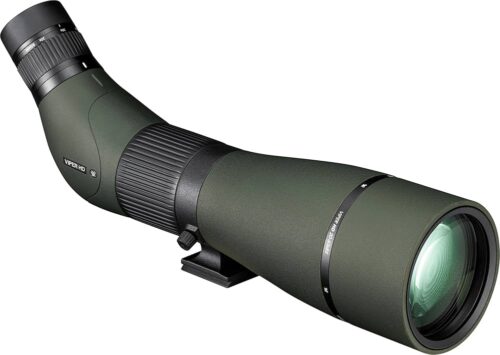
Looking for the best spotting scopes for birding? You are in the right place. Finding the right spotting scope makes all the difference in your birdwatching adventures, letting you see birds in stunning detail at much greater distances and in different habitats.
In this guide, we’ll walk you through the key features to consider when choosing a spotting scope, explain what specifications matter for birding, and share some of the top options available across a range of budgets and experience levels. Whether you’re just getting into birding or looking to upgrade your gear, this guide will help you make a confident, informed choice.
Why a Spotting Scope for Bird Watching?
1. Long-Distance Viewing. Spotting scopes provide much higher magnification than binoculars, making it easier to observe birds that are far away or easily disturbed.
2. Exceptional Detail. They allow you to see fine details such as plumage patterns, beak shape, and subtle color variations. These features are key for accurate bird identification.
3. Ideal for Open Habitats. The best spotting scopes for birding are perfect for birding in wetlands, grasslands, coastlines, and lakes where birds are often too distant for binoculars alone.
4. Reduced Disturbance. Furthermore, the high magnification lets you observe birds without getting too close, helping avoid stress or disruption to wildlife.
5. Great for Stationary Observation. Spotting scopes excel when watching birds for extended periods, such as during migration counts or at nesting sites.
6. Digiscoping Capability. Many spotting scopes are compatible with cameras or smartphones, allowing you to capture photos and videos of birds.
7. Improved Learning Experience. Seeing birds clearly helps beginners and experienced birders alike learn distinguishing features more quickly.
8. Complements Binoculars. Last but not least, a spotting scope works alongside binoculars. Binoculars are excellent for scanning and the spotting scope for detailed inspection.
Best Spotting Scopes for Birding
1) Celestron – Regal M2 100ED Spotting Scope – Best Overall
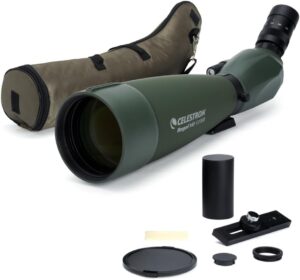
The Celestron Regal M2 100ED Spotting Scope is the best spotting scope for bird watching. It is designed with ease of use in mind for birders who demand exceptional optical performance.
The 100mm objective lens combined with ED (Extra-low Dispersion) glass delivers bright, high-contrast images with excellent color fidelity, even in challenging lighting conditions such as early mornings or overcast days.
Furthermore, the scope produces sharp detail across the field of view, with minimal chromatic aberration. This makes it ideal for identifying distant birds, animals, or landscape features.
The dual-focus system featuring both coarse and fine adjustment knob allows for fast target acquisition and precise focusing, which is especially helpful at higher magnifications.
Moreover, this spotting scope is built for durability and versatility. It features a rugged magnesium alloy body that is both lightweight for its size and highly resistant to field abuse. Additionally, the optical tube is fully waterproof and nitrogen-purged to prevent fogging, ensuring reliable performance in wet or humid environments.
Pros
- ED glass minimizes color fringing and enhances clarity
- Dual-focus system allows quick and precise focusing
- Rugged magnesium alloy body for durability
- Waterproof and fog-proof for all-weather use
- Angled eyepiece improves viewing comfort and versatility
- Excellent performance for digiscoping
Cons
- Larger size and weight compared to smaller spotting scopes
- Premium price for casual users
2) Swarovski Optik ATS-65 HD Spotting Scope with 20×60 Eyepiece – Best for the Money
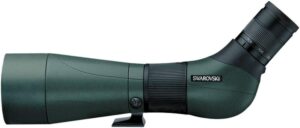
The Swarovski ATS-65 HD Spotting Scope with the 20×60 eyepiece delivers stunning optical clarity that consistently impresses, whether you’re observing wildlife, scanning landscapes, or targeting distant features on the horizon.
The optics produce bright, high-resolution images with rich contrast and accurate color reproduction. This makes details easy to pick out even in lower light conditions like dawn or dusk.
Furthermore, the 65 mm objective gathers plenty of light without becoming bulky, and the angled eyepiece design feels natural when observing birds in the air or trees.
Regarding construction, the build quality is excellent. The scope feels solid yet balanced, and its weatherproof construction gives confidence in fog, rain, or dusty environments.
To complement the robust build quality, focusing is smooth and precise, letting you quickly lock onto subjects without overshooting or jitter. Furthermore, the field of view at 20x is wide enough to follow birds or fast-moving animals, and eye relief is generous, making it comfortable for eyeglass wearers.
Above all, carrying and mounting are straightforward thanks to the ergonomic design and well-placed tripod connection, and the overall setup is refined and thoughtfully engineered.
Pros
- Exceptional optical clarity, contrast, and color accuracy
- Bright images even in challenging light
- Comfortable angled eyepiece for long viewing sessions
- Smooth, precise focus mechanism
- Solid, weatherproof build quality
- Wide field of view and good eye relief
Cons
- Sits at a premium price point
3) SVBONY SV406P 20-60×80 Angled Spotting Scopes – Best for Beginners
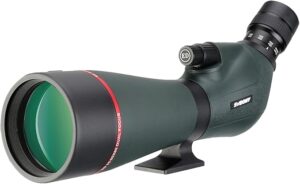
As one of the best spotting scopes for birding, the SVBONY SV406P 20–60×80 angled spotting scope delivers an impressive viewing experience for both beginners and more advanced outdoor enthusiasts.
The solid build and comfortable angled eyepiece guarantee premium performance in different birding environments.
Furthermore, the zoom range from 20x to 60x gives you a lot of flexibility, letting you scan a wide field at lower magnification and then zoom in for detailed views of distant subjects.
Color and contrast are impressive, especially in bright daylight, and the 80mm objective lens gathers plenty of light so that images stay bright and clear even during early morning or late evening outings. Additionally, the angled design is especially helpful when observing wildlife or birds in trees, as it makes long viewing sessions easier on your neck.
This spotting scope also performs well in challenging conditions. The focus knob is smooth and responsive, so you can quickly lock onto fast-moving subjects. It’s also fairly rugged, with weather-resistant sealing that stands up to mist and light rain.
Pros
- Wide zoom range (20–60x) for versatile viewing
- Bright, clear images with good color balance in daylight
- Comfortable angled eyepiece for extended use
- Smooth focusing mechanism
- Generous light gathering from the 80mm objective
- Weather-resistant for outdoor use
Cons
-
The image sharpness drops slightly at highest magnification
4) Nikon Monarch 20-60×82 ED Spotting Scope – Best for Color Accuracy
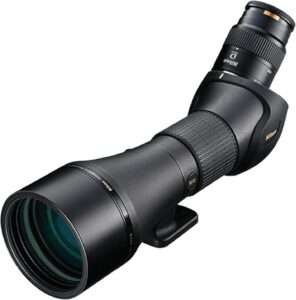
This spotting scope features premium ED glass that minimizes chromatic aberration and color fringing, ensuring vivid images with superior contrast and precision color accuracy across all magnification levels
The advanced optical design corrects curvature across the entire field of view, providing uniform resolution and crisp detail from center to edge. It also reduces distortion and visual fatigue during extended observation sessions
Regarding lens coatings, all lenses and prisms are fully multilayer coated to enhance light transmission, delivering exceptional contrast, and detail even in dawn, dusk, or overcast conditions.
Furthermore, this spotting scope is built ready for outdoor use. It is crafted with an aluminum-alloy body, nitrogen-filled chamber, and O-ring seals to resists fog, moisture, and dust intrusion, maintaining optical integrity and durability in harsh environments.
What’s more, the angled configuration provides a comfortable viewing position when observing elevated subjects or during prolonged use. It is also ideal for scanning treetops, birdwatching, reducing neck strain & allowing multiple users of different heights.
Pros
- Exceptional image clarity with ED glass that reduces color fringing
- Large 82mm objective lens provides bright views in low-light conditions
- Wide 20–60x zoom range for versatile long-distance viewing
- Rugged, waterproof, and fog-proof construction
- Comfortable angled eyepiece ideal for prolonged observation
- Good eye relief, suitable for eyeglass wearers
Cons
-
Large size and weight
5) Vortex Optics Razor HD Spotting Scopes – Best Focus Accuracy
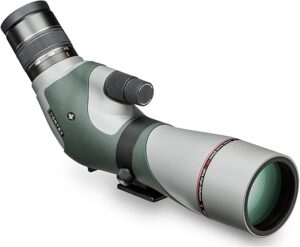
Available in 20-60×85 and 16-48×65 angled configurations, the Vortex Optics Razor HD Spotting Scopes are long-term investment for professionals and enthusiasts who prioritize durability and uncompromising image quality.
Featuring high-density (HD) extra-low dispersion glass, the Razor HD delivers exceptional resolution, accurate color fidelity, and impressive contrast across the entire magnification range. Images remain sharp and bright even at high power, making it ideal for long-range birdwatching and glassing in low-light conditions.
Optically, the advanced optical coatings effectively reduce glare and improve light transmission, allowing fine details to stand out clearly at dawn, dusk, or over long distances.
Beyond optical performance, the Razor HD is engineered for serious outdoor use. Its magnesium alloy chassis offers a strong yet lightweight build, while the rubber-armored exterior provides a secure grip and added impact protection.
Furthermore, the scope is fully waterproof, fog-proof, and shockproof, ensuring reliable performance in harsh weather and rugged environments. It also features a smooth, precise focusing system for quick adjustments, and an angled body design to cater to different viewing preferences.
Pros
- Exceptional HD glass with outstanding clarity and color accuracy
- Bright, sharp images even at high magnification
- Rugged magnesium alloy construction with weatherproof sealing
- Smooth and precise focus controls
- Excellent low-light performance
- Lifetime warranty for long-term peace of mind
Cons
-
Heavier than entry-level spotting scopes
6) GUANIEE Digital Spotting Scope with Screen Portable Auto-Focus – Best for Digiscoping
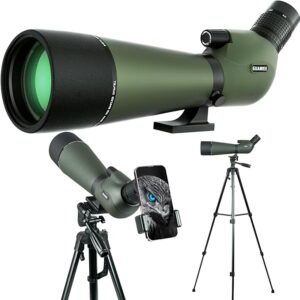
Next, we have the GUANIEE Digital Spotting Scope.
This spotting scope is easy to zoom in with variable 25x to 75x magnification and dynamic lens focusing system. Additionally, it is built with versatility in mind which makes it a great choice for target shooting, bird watching wildlife, hiking, camping, and archery.
The adjustable tripod included varies from 20″-46″ in height for different viewing positions. Furthermore, a universal phone adapter, cleaning cloth, carrying bag, eyepiece and objective lens protective cover are included to help take photos and videos of what you have observed from any angle and bring the nature closer to you easily through the phone screen
Regarding optical performance, the spotting scope lens feature fully multi-coated and BAK4 roof prism to increases light transmission and delivers bright and clear images even in low-light conditions. Besides, the 80mm objective lens provides a large field of view at 123-63ft / 1000 yards for easy tracking of flying birds.
Construction-wise, this spotting scope features a high-quality rubber armor that provides non-slip grip, shock-proof grip and external protection. The extendable sunshade built onto the main barrel reduces glare, while the 45 degree angled eyepiece provides more comfortable viewing.
In addition to everything else, this spotting scope is waterproof and fog-proof to cope with rainy and snowy days.
Pros
- Integrated digital camera for photos and videos
- Easy-to-use controls and menu system
- Digital zoom enhances long-range viewing
- Portable and travel-friendly design
- Rechargeable battery for extended use
Cons
- The optical performance drops in low-light conditions
7) Nexiview 25-75×80 HD Spotting Scope – Best Versatile
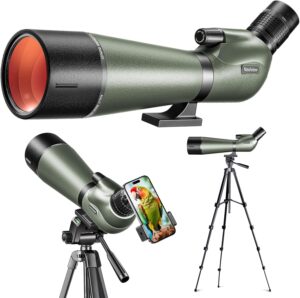
The Nexiview 25-75×80 HD Spotting Scope delivers an impressive combination of power and clarity, making it ideal for birdwatching, wildlife observation, and long-range viewing.
Its wide 80mm objective lens allows for exceptional light transmission, providing bright and clear images even in low-light conditions like dawn or dusk. Furthermore, the 25-75x magnification zoom range gives users the flexibility to quickly adjust from wide-field views to detailed close-ups without losing focus.
Constructed with high-quality optical glass and fully multi-coated lenses, this spotting scope ensures sharp, color-accurate visuals with minimal distortion, making every detail stand out. Additionally, its angled design allows for comfortable viewing over extended periods, reducing neck strain during long observation sessions.
Durability and portability are other strong points for the Nexiview HD Spotting Scope. Its body is made from lightweight yet robust materials and is weather-resistant, allowing it to withstand outdoor conditions such as rain, fog, and dust.
Above all, the focus system is smooth and precise, enabling quick adjustments without frustrating lag or stiffness.
Pros
- Wide 80mm objective lens for bright, clear images
- 25-75x magnification for versatile viewing
- Fully multi-coated optics for sharp, color-accurate visuals
- Angled design for comfortable extended use
- Weather-resistant and durable build
- Smooth and precise focus mechanism
- Tripod compatibility for stable long-distance viewing
Cons
-
Larger and heavier than other portable spotting scopes
8) Gosky EagleView Spotting Scope 20-60x 85 – Honorary Recommendation
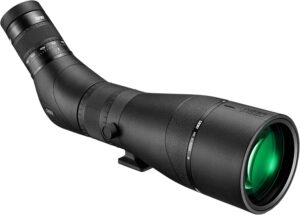
Lastly, we have the Gosky EagleView Spotting Scope 20-60x 85 spotting scope. This is a versatile and high-powered optic designed for birdwatching, hunting, and long-distance observation.
Its 85mm objective lens allows for bright and clear images even in low-light conditions, while the 20-60x magnification range provides flexibility for both wide-field views and detailed close-ups.
Furthermore, the scope features fully multi-coated optics that enhance light transmission and reduce glare, producing crisp, sharp images with accurate color reproduction.
As one of the best spotting scopes for birding, its durable construction, combined with a waterproof and fog-proof design, makes it reliable in various weather conditions, whether you’re out in the rain or exploring humid environments.
The included adjustable tripod mount ensures stable viewing, and the rotating angled eyepiece offers comfortable eye positioning for extended observation sessions. This spotting scope also features dual coarse and fine focus knobs that make it easy to lock onto fast-moving subjects quickly.
Pros
- High magnification range
- Large 85mm objective lens for bright, clear images
- Fully multi-coated optics for reduced glare and enhanced clarity
- Waterproof and fog-proof for use in various weather conditions
- Adjustable tripod mount and angled eyepiece for comfort
- Durable, rubber-armored exterior for secure handling
Cons
-
Slightly heavier than compact spotting scopes
Key Factors to Consider when Choosing the Best Spotting Scopes for Birding
When selecting a spotting scope for birding, take into consideration these key factors:
Magnification Power
Firstly, magnification power is one of the most critical factors to consider. Birdwatchers often need to observe small birds at a distance, so a scope with variable magnification, such as 20–60x, allows for flexibility. Lower magnification gives a wider field of view, making it easier to locate birds, while higher magnification provides more detail for identification. It’s important to choose a scope that balances magnification with image clarity to avoid blurry or shaky views.
Objective Lens Size
The objective lens diameter is another essential consideration. A larger objective lens, measured in millimeters, captures more light, producing brighter and clearer images, especially in low-light conditions such as dawn or dusk. However, larger lenses also make the scope heavier and less portable, so it is important to find a balance between optical performance and ease of use in the field.
Optical Quality
Next, optical quality plays a significant role in spotting scopes. High-quality glass and advanced coatings reduce glare and enhance color accuracy, contrast, and sharpness. Look for fully multi-coated lenses and ED (extra-low dispersion) glass, which minimizes chromatic aberration and improves overall image quality.
Build Quality
The build quality and durability of the best spotting scopes for birding determine how well they withstand outdoor conditions. Many scopes are made waterproof, fog-proof, and shock-resistant, which protects the optics from rain, humidity, or accidental bumps. The scope should also have a robust, weatherproof body to ensures longevity and reliable performance during long birding trips, whether in forests, wetlands, or coastal areas.
Weight and Portability
Moreover, portability and weight are practical considerations, especially for birders who hike long distances. Compact and lightweight spotting scopes are easier to carry and set up quickly, but they may sacrifice some optical performance compared to larger models. Tripods also add to the total weight, so it’s important to choose a scope that balances portability with stability and image quality.
Eye Relief
The eye relief and viewing comfort are vital for extended observation sessions. Eye relief is the distance between your eye and the eyepiece where you can still see the full field of view. Scopes with longer eye relief are particularly helpful for people who wear glasses. Additionally, ergonomic designs and rotating or angled eyepieces enhance comfort during long periods of birdwatching.
Price and Warranty
Lastly, price and warranty are practical factors that influence your choice. The best spotting scopes for birding range widely in cost, from affordable beginner models to high-end professional optics. Consider your budget while also factoring in the reputation of the brand, included accessories, and warranty coverage. Investing in a quality scope with a solid warranty often saves money in the long run and ensures you have a reliable tool for many years of birding adventures.
Read Also
- 8 Best Image Stabilized Binoculars for Birding
- 7 Best Budget Spotting Scope for Target Shooting
- 6 Best Spotting Scopes with Reticle
Tips for Best Birding Results with a Spotting Scope
1. Use a sturdy tripod: A solid tripod reduces shake and ensures a stable image, especially at high magnifications. Lightweight but robust tripods are ideal for carrying on hikes.
2. Choose the right location and time: Birds are most active during early mornings and late afternoons. Position yourself in areas where birds gather, such as near water, feeding spots, or tree canopies.
3. Adjust magnification carefully: Start with lower magnification to locate the bird, then increase it to see fine details. Avoid max magnification unless necessary, as higher zoom makes images shakier.
4. Keep lenses clean: Use a soft lens cloth or brush to remove dust and smudges. Clean optics ensure brighter, sharper images and prevent scratches.
5. Learn proper focusing techniques: The best spotting scopes for birding have both coarse and fine focus adjustments. Practice using both to quickly sharpen images and track moving birds efficiently.
6. Protect your scope from weather: Even if your scope is waterproof, avoid prolonged exposure to rain or sand. Use a protective cover or bag during transport.
7. Practice patience and observation: Birds stay still for only a few moments. Be ready to observe quietly and slowly adjust your scope to catch every detail without startling them.
FAQs
- What magnification is best for birding?
For most birdwatching excursions, a variable magnification between 20x and 60x works well. Lower magnification gives a wider field of view to locate birds, while higher magnification allows detailed observation once the bird is spotted.
- Should I get a straight or angled spotting scope?
Angled scopes. These spotting scopes are easier to use for observing birds at different heights or when using a tripod for long periods.
- Do I need a waterproof spotting scope?
Yes. A waterproof and fog-proof scope is ideal for birding in varying weather conditions. These features protect the internal optics from moisture, fog, and dust, extending the life of your scope.
Conclusion
Hopefully, you have found this buying guide comprehensive and insightful. Choosing the best spotting scopes for birding is a balance of optics, durability, and practicality. Pay attention to magnification, objective lens size, optical quality, and portability, to find a scope that fits your birdwatching style and environment.