
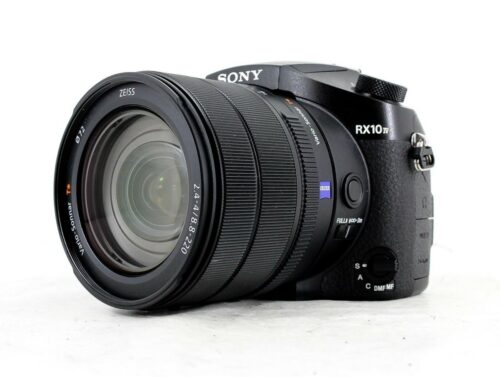
1. OM SYSTEM Olympus OM-1 Mark II Micro Four Thirds System Camera – Best Overall
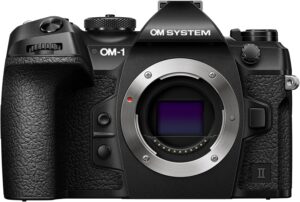
The OM SYSTEM Olympus OM-1 Mark II is the best camera for bird photography. It is a powerhouse Micro Four Thirds camera that combines portability with professional-level performance.
Featuring a 20MP BSI stacked sensor, it delivers impressive image quality with remarkable clarity, even in challenging low-light conditions. Furthermore, the fast autofocus system is highly responsive, making it ideal for action photography, wildlife, and fast-moving subjects.
Its compact and weather-sealed body ensures durability in various shooting environments, while the advanced image stabilization system provides sharp handheld shots, even with longer lenses. Moreover, the electronic viewfinder and fully articulating LCD screen offer flexibility for creative compositions, from traditional photography to vlogging and content creation.
In addition to its strong imaging capabilities, the OM-1 Mark II excels in speed and versatility. It boasts rapid continuous shooting, allowing photographers to capture split-second moments with precision. The camera also supports high-resolution video recording, including 4K and the menu navigation and controls are intuitive, giving photographers quick access to essential settings without slowing down their workflow.
Pros
- Excellent 20MP BSI stacked sensor with strong low-light performance
- Fast and accurate autofocus system
- Advanced in-body image stabilization for sharp handheld shots
- Compact, lightweight, and weather-sealed body
- Fully articulating LCD and high-resolution electronic viewfinder
- Rapid continuous shooting ideal for action photography
- 4K video recording for hybrid photo/video use
- Wide range of compatible Micro Four Thirds lenses and accessories
Cons
- Short battery life during heavy continuous shooting or video recording
- Slight learning curve for beginners due to extensive features and menu options
2. Canon EOS R7 Mirrorless Camera – Best Crop-Sensor Mirrorless
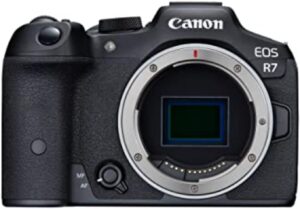
The Canon EOS R7 Mirrorless Camera is a standout option for photographers and videographers looking for a versatile hybrid camera.
Its 32.5-megapixel APS-C CMOS sensor delivers impressive image quality, capturing sharp, detailed photos even in challenging lighting conditions.
Furthermore, the camera’s DIGIC X processor ensures fast performance, enabling quick autofocus, rapid continuous shooting, and smooth operation. Its compact, lightweight design makes it ideal for travel, street photography, and wildlife shooting, while the fully articulating LCD touchscreen adds flexibility for creative angles and vlogging.
More importantly, the camera offers dual pixel autofocus with eye detection, providing accurate tracking of moving subjects.
In addition to still photography, the EOS R7 excels in video capabilities. It supports 4K video recording at high frame rates, allowing for cinematic-quality footage and slow-motion options. The in-body image stabilization (IBIS) helps minimize shake during handheld shooting, making videos smoother without the need for additional stabilizers.
To top it all off, connectivity options such as Wi-Fi and Bluetooth make sharing and remote control straightforward, while the robust build ensures durability for outdoor and on-the-go use.
Pros
- High-resolution 32.5 MP APS-C sensor for detailed images
- 4K video recording with high frame rate options
- Dual Pixel autofocus with eye detection
- In-body image stabilization (IBIS)
- Lightweight and compact mirrorless design
- Fully articulating touchscreen for flexible shooting angles
- Fast continuous shooting and responsive performance
Cons
-
Body only; lens purchase required separately
3. Nikon D850 FX-Format Digital SLR Camera Body – Best Professional-Level Option
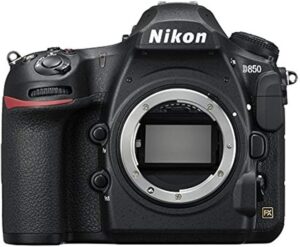
The Nikon D850 FX-Format Digital SLR Camera Body is designed for professional photographers who demand top-tier image quality and versatility.
Featuring a 45.7-megapixel full-frame sensor, this camera delivers stunning detail and dynamic range, making it ideal for landscapes, portraits, and studio work. It also excels in low-light situations with its impressive ISO range and noise control.
The EXPEED 5 image processor ensures fast and precise performance with 153-point autofocus and advanced metering. Additionally, the camera offers 4K UHD video recording, allowing creators to shoot high-quality video without compromise.
Handling and durability are other notable features of the D850. Its robust magnesium alloy body is weather-sealed, making it reliable in demanding environments. Furthermore, the tilting touchscreen LCD and intuitive control layout provide an excellent user experience, whether shooting handheld or on a tripod.
Pros
- Extremely high-resolution 45.7 MP sensor
- Excellent dynamic range and low-light performance
- 153-point autofocus system for precise focus
- 4K UHD video recording
- Robust, weather-sealed body
- Long battery life and fast continuous shooting
Cons
-
Large and heavy compared to mirrorless alternatives
4. Sony a9 Full Frame Mirrorless Interchangeable-Lens Camera – Best for the Money
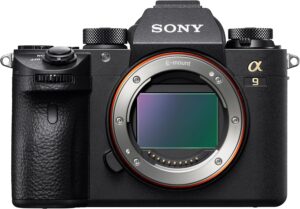
The Sony a9 Full Frame Mirrorless Interchangeable-Lens Camera is a professional-grade powerhouse designed for photographers who demand speed, precision, and reliability.
Its full-frame sensor delivers exceptional image quality with stunning detail and dynamic range, making it ideal for sports, wildlife, and action photography.
Another impressive feature is its lightning-fast 20 frames per second continuous shooting with no viewfinder blackout. This allows users to capture every fleeting moment with accuracy.
Coupled with Sony’s advanced autofocus system, which tracks moving subjects with remarkable precision, the a9 ensures sharp results even in challenging conditions. Additionally, the electronic viewfinder provides a bright, real-time preview, while the fully articulated touchscreen makes composing and reviewing shots intuitive and convenient.
Beyond performance, the Sony a9 is built with professional usability in mind. Its robust magnesium alloy body is weather-sealed, offering durability for demanding environments.
Other features it is couple with include dual card slots that provide ample storage and backup, and Wi-Fi and Bluetooth for seamless file transfer and remote control.
Pros
- Ultra-fast 20 fps continuous shooting with no blackout
- Advanced real-time autofocus tracking
- Exceptional full-frame image quality and dynamic range
- Durable, weather-sealed magnesium alloy body
- High-resolution electronic viewfinder
- Dual card slots for flexibility and backup
- Extensive connectivity for modern workflows
Cons
-
Expensive compared to other mirrorless cameras
5. Nikon COOLPIX P1100 Superzoom Digital Camera – Best Budget
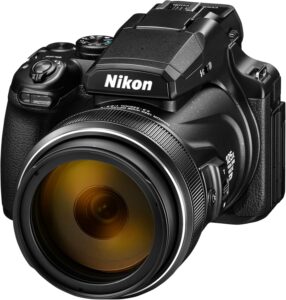
Next, we have the Nikon COOLPIX P1100 Superzoom Digital Camera is a versatile compact camera that impresses with its incredible zoom range and user-friendly features.
It sports a powerful 125x optical zoom lens, allowing you to capture distant subjects with remarkable clarity, from birds in the far distance to wildlife details miles away.
Furthermore, the camera’s 16-megapixel BSI CMOS sensor delivers sharp and vibrant images even in challenging lighting conditions, while its built-in image stabilization helps reduce blur for crisp shots.
Its large 3-inch LCD screen makes framing and reviewing photos easy, and the P1100 offers full HD 1080p video recording, giving you flexibility for both stills and video.
Regarding portability, the camera is compact and lightweight. This makes it suitable for travel, birdwatching, and everyday photography where carrying a full DSLR isn’t practical.
Its intuitive menu system ensures a smooth learning curve for beginners, while more advanced users can take advantage of RAW shooting and creative effects. The camera is also equipped with various shooting modes, including scene presets and manual controls for enthusiasts who like to experiment with exposure, shutter speed, and aperture.
Pros
- Extremely powerful 125x optical zoom for distant subjects
- Sharp 16MP images with decent low-light performance
- Full HD 1080p video recording
- Built-in image stabilization reduces blur
- Lightweight and travel-friendly for a superzoom camera
- User-friendly interface with manual and creative controls
Cons
- Smaller sensor than DSLRs, limiting dynamic range
- The autofocus is slower at extreme zoom levels
6. Sony Cyber‑Shot RX10 IV – Best All-in-One
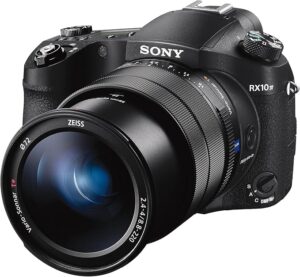
The Sony Cyber‑Shot RX10 IV is a high-performance all-in-one bridge camera that caters to both serious enthusiasts and professionals who want versatility without carrying multiple lenses.
Equipped with a 1-inch 20.1MP stacked CMOS sensor and Sony’s BIONZ X image processor, it delivers sharp, detailed images even in challenging lighting conditions.
Another highlight feature is the ZEISS Vario-Sonnar T* 24–600mm f/2.4–4 lens. It offers an impressive zoom range that covers everything from wide-angle landscapes to distant wildlife or sports action. Furthermore, the autofocus performance is exceptional, with 315 phase-detection points and real-time tracking, allowing photographers to capture fast-moving subjects with remarkable accuracy.
What’s more, the camera supports 4K video recording with full pixel readout, minimal rolling shutter, and excellent color reproduction. The electronic viewfinder is also bright and responsive, providing a near-optical experience.
Handling and usability are equally impressive, thanks to a robust, weather-sealed magnesium alloy body, a comfortable grip, and a fully articulating LCD screen that makes shooting from creative angles effortless.
Pros
- Extremely versatile 24–600mm f/2.4–4 lens
- Fast and accurate autofocus with real-time tracking
- 4K video recording with excellent color and detail
- High-speed continuous shooting at 24 fps
- Robust, weather-sealed body with good ergonomics
- Fully articulating LCD and bright electronic viewfinder
Cons
-
No interchangeable lenses, limiting future upgrades
7. Canon PowerShot SX70 HS Digital Camera – Best Beginner-Friendly
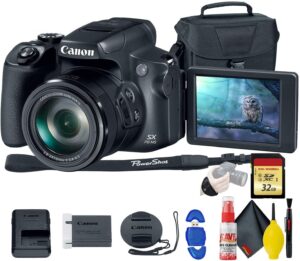
Last but not least, we have the Canon PowerShot SX70 HS Digital Camera. This is a versatile bridge camera designed for photography enthusiasts who want a powerful zoom and advanced features without the bulk of a DSLR.
As the best camera for bird photography for beginners, the massive 65x optical zoom lens allows you to capture distant subjects with remarkable clarity.
Furthermore, the 20.3-megapixel CMOS sensor ensures detailed images, while the DIGIC 8 processor delivers fast performance and accurate color reproduction.
The electronic viewfinder included provides a clear and bright view even in bright sunlight, and the fully articulating LCD screen that makes framing shots from creative angles easy. Additionally, the camera supports 4K video recording, enabling high-quality video capture alongside still photography.
Beyond its impressive zoom and image quality, the Canon PowerShot SX70 HS is packed with user-friendly features. Its built-in Wi-Fi and Bluetooth connectivity allow for seamless sharing and remote control via a smartphone or tablet. The camera also offers multiple shooting modes, including full manual control for advanced users and scene presets for beginners.
Pros
- 65x optical zoom lens for extreme reach
- 20.3 MP sensor with DIGIC 8 processor
- 4K video recording capability
- Fully articulating LCD screen
- Effective image stabilization
- Built-in Wi-Fi and Bluetooth
Cons
-
Larger and heavier than compact cameras
Criteria for Choosing the Best Camera for Bird Photography
Whether you are buying a bird photography camera for the first time or looking for an upgrade, consider these key factors when making your selection.
Sensor Size and Type
For starters, the sensor is the heart of any camera, and for bird photography, it plays a critical role in image quality and low-light performance. Full-frame sensors offer excellent detail and dynamic range, but crop sensors can provide extra reach, which is useful for distant birds. Consider whether you want a CMOS or CCD sensor, as modern CMOS sensors generally handle noise better and allow for faster shooting speeds, crucial when capturing fast-moving birds.
Autofocus Performance
Birds are unpredictable and often move quickly, so a camera with a fast and accurate autofocus system is essential. The best camera for bird photography should have advanced tracking capabilities, multiple focus points, and eye or animal detection features. Continuous autofocus (AF-C) and predictive tracking is also important as it helps ensure your shots remain sharp, even when birds are in flight or darting between branches.
Frame Rate (Continuous Shooting Speed)
The speed at which a camera can take consecutive shots is vital for action-packed bird photography. A higher frame rate allows you to capture multiple frames during a bird’s quick movements, increasing your chances of getting the perfect shot. Cameras offering 10 frames per second (fps) or more are ideal, especially when paired with a buffer that can handle long bursts without slowing down.
Lens Compatibility
The best camera for bird photography is only as good as the lenses you can use with it. Bird photography typically requires telephoto lenses with long focal lengths, sometimes 300mm or more. Ensure the camera has a wide range of compatible lenses, good support for teleconverters, and that autofocus remains reliable even with heavy or extended lenses.
Image Stabilization
Birds often require shooting at long distances or with high zoom levels, which can make handheld shots prone to blur. In-body image stabilization (IBIS) or lens-based stabilization helps reduce motion blur and camera shake. This is particularly important when shooting in low-light conditions, where slower shutter speeds are necessary.
Durability and Weather Resistance
Next, consider durability and weather resistance. Bird photography often takes place outdoors in unpredictable conditions. A camera with a weather-sealed body, robust build, and dust- and moisture-resistance ensures it can handle rain, wind, or dusty environments. Durability also contributes to long-term reliability, which is crucial for fieldwork where replacements or repairs aren’t immediately available.
ISO Range and Low-Light Performance
Lastly, consider ISO range and low-light performance. Birds are often most active during dawn or dusk, times when natural light is limited. A camera with a wide ISO range and strong low-light performance allows you to maintain fast shutter speeds without introducing excessive noise. Look for cameras with good high-ISO capability and noise reduction technology to capture crisp, clear images even in challenging lighting conditions.
Read Also
- 10 Best Camera Backpacks
- 7 Best Lightweight Spotting Scope for Bird Watching
- 7 Best Binoculars for Farming
Top 10 Bird Photography Tips
-
Know Your Camera. Familiarize yourself with manual, aperture priority, and shutter priority modes. Understanding these settings will help you react quickly to fast-moving birds.
-
Fast Shutter Speed. Use at least 1/1000s for flying birds or fast movements to avoid motion blur, ensuring crisp, sharp shots.
-
Use Continuous Autofocus (AF-C). Keeps the bird in focus as it moves. Pair it with tracking features if your camera has them to follow erratic flight patterns.
-
High-Speed Burst Mode. Shoot in rapid bursts to capture the perfect moment, such as a bird taking off or catching prey mid-flight.
-
Pick the Right Lens. Telephoto lenses (300–600mm) are ideal for distant subjects. Longer lenses or teleconverters help reach shy or small birds without disturbing them.
-
Focus on the Eyes. Furthermore, sharp eyes draw viewers into the photo and make the image feel alive, especially for perched or close-up birds.
-
Shoot During Golden Hours. Early morning and late afternoon provide soft, warm light and less harsh shadows, enhancing colors and details.
-
Stay Steady. Use a tripod or monopod for stability. If handheld, tuck your elbows in and use the camera strap for support. Image stabilization also helps reduce blur.
-
Respect Wildlife. Always avoid disturbing birds or their nests. Keep a safe distance, minimize noise, and respect wildlife laws. Ethical practices ensure you don’t stress the animals and maintain sustainable bird photography habit.
- Practice Patience. Last but not least, bird photography requires patience and quiet observation. Watch their behavior, learn favorite perching spots, and wait for the perfect moment. Using blinds or natural cover helps you stay unseen and get closer to shy species.
FAQs
- Do I need a full-frame camera for bird photography?
Not necessarily. While full-frame cameras offer excellent image quality and low-light performance, crop-sensor cameras can provide extra reach with telephoto lenses, which is very useful for photographing distant birds.
- What lens focal length is best for birds photography?
Telephoto lenses of 300mm or longer are ideal for most bird photography. Longer lenses (400mm–600mm) are often preferred for small or shy birds, while teleconverters can help extend your reach without buying a new lens.
- Can I shoot birds in low light with a regular camera?
Yes, but you need a camera with strong ISO performance and good low-light capabilities. This allows faster shutter speeds without excessive noise, which is crucial during early morning or late evening when birds are most active.
- How fast should my camera’s continuous shooting be?
A camera with at least 8–10 frames per second (fps) is ideal for capturing birds in flight or sudden movements. Faster frame rates increase the chance of getting the perfect shot in action sequences.
Final Words
The best camera for bird photography depends on your experience level and shooting style. Bridge cameras are ideal for convenience and extreme reach, while mirrorless and DSLR systems offer better image quality and autofocus performance when paired with telephoto lenses. Invest in a good lens and the right camera body to get the most out of your photography.